

What Is an Online Symptom Checker?
An online symptom checker is a website or mobile app that asks you to describe your symptoms and then suggests conditions that could explain them. Most tools also provide basic triage guidance, which means they estimate how urgently you should get medical attention.
A symptom checker sits between a simple web search and a visit with a healthcare professional. It is more organized than scrolling through random search results, and it is available at any hour of the day. But it cannot examine you, run tests, or consider your complete medical history, which is why it works best as a guide to your next step rather than a final answer.
How Does an Online Symptom Checker Work?
The details differ from one tool to the next, but most follow a similar path. First, you enter basic information such as your age and sex, because many conditions are more or less likely depending on these factors. Next, you describe your main symptom, either by choosing from a list, clicking on a body diagram, or typing it in your own words.
The tool then asks follow-up questions about how long the symptom has lasted, how severe it is, what makes it better or worse, and whether you have any related symptoms. Finally, it presents a list of possible conditions, often ranked by likelihood, together with a recommendation about the level of care you may need.
Behind the scenes, traditional symptom checkers use a structured medical knowledge base that links symptoms to conditions and weighs how often each condition causes each symptom. Newer tools use artificial intelligence and machine learning to interpret free-text descriptions and adjust their questions as you go. Either way, the tool is matching patterns, not examining a patient, so it works more like a guided lookup than a doctor’s reasoning.
Types of Online Symptom Checkers
Not all symptom checkers are built the same way. Understanding the main types helps you choose a tool that fits your situation.
Rule-based checkers walk you through a fixed set of questions and use pre-programmed logic to narrow down possibilities. They are predictable and easy to follow, though they can be rigid when your situation does not fit the script. AI-powered checkers use machine learning to interpret your answers and adapt the conversation, which can feel more natural but is harder to evaluate, since it is not always clear how a conclusion was reached.
Triage-focused tools, often run by health systems and public health services, put the emphasis on how urgently you need care rather than on naming a diagnosis. Telehealth-linked apps combine a symptom check with the option to speak to a clinician by video or chat. Finally, general-purpose AI chatbots can discuss symptoms in plain language, but they are not purpose-built medical tools and should be treated as a source of general information only.
Tool features, ownership, and availability change often, so check each tool’s current description and privacy policy before you rely on it.
How Accurate Are Online Symptom Checkers?
Accuracy is the most important question, and the research gives a sobering but nuanced answer. A well-known 2015 study in the BMJ tested 23 symptom checkers against 45 clinical scenarios. The correct diagnosis appeared first in the results only about a third of the time, and within the top 20 results in just under 60 percent of cases. Triage advice was appropriate in a little over half of the cases, and the tools tended to be overly cautious, recommending care more often than needed.
Later studies have found wide variation between tools, and newer AI-based systems often perform better than older rule-based ones. Even so, no consumer symptom checker has been shown to match the reliability of an in-person clinical assessment.
A few themes appear again and again. Triage advice is often more useful than the diagnosis list, because knowing whether to go to the emergency room, book an appointment, or rest at home is the most practical outcome. Tools lean cautious by design, because missing a serious condition is considered worse than suggesting an unnecessary visit. Common, well-defined problems tend to be handled better than rare or ambiguous ones. And the quality of your answers matters: misunderstanding a question or leaving out a relevant detail weakens the result.
Benefits of Using an Online Symptom Checker
Used sensibly, a symptom checker offers real advantages. It helps you prepare for a doctor’s visit by organizing your symptoms so you can describe them clearly and completely. It builds health literacy, since reading about possible causes helps you understand medical terms and ask better questions.
For mild, common issues, it can confirm that self-care is reasonable. In places with long waits, high costs, or few clinicians, a free tool can be a useful first step. It is also available around the clock and is usually a better choice than wandering through random forum posts at midnight.
Risks and Limitations of Symptom Checkers
Cyberchondria and Health Anxiety
Cyberchondria describes the pattern of rising health anxiety fueled by online searching. When a symptom checker lists a frightening diagnosis, it is easy to fixate on it even if it is statistically very unlikely. If you notice that checking symptoms increases your anxiety rather than easing it, that is a sign to step away and talk to a healthcare professional.
False Reassurance
The opposite problem is just as real. A result suggesting a mild cause might lead you to delay care for something that deserves attention. Symptoms that are severe, persistent, or getting worse should never be dismissed because an online tool said they were probably minor.
No Physical Exam or Full Medical History
A symptom checker cannot look at your skin, listen to your heart, or review your lab results. Your medical history, current medications, family history, and lifestyle all matter, and a short questionnaire cannot capture them fully.
Self-Diagnosis and Self-Treatment
Taking medication or changing your health routine based only on a checker’s output can be risky, especially if you have other conditions or take other drugs.
Privacy of Your Health Data
Symptom information is sensitive. Before entering detailed information, read the privacy policy to understand how data is stored, shared, or used for advertising or research, and avoid entering identifying details unless the tool genuinely needs them.
When to Skip the Symptom Checker and Get Emergency Help
Some situations call for emergency care, not an online tool. Contact local emergency services or go to the nearest emergency department if you or someone else has chest pain or pressure, especially with shortness of breath, sweating, or pain spreading to the arm or jaw. The same applies to signs of stroke such as sudden facial drooping, arm weakness, confusion, or trouble speaking, as well as severe difficulty breathing, a sudden and severe headache unlike any before, heavy bleeding that will not stop, loss of consciousness, seizures, or signs of a severe allergic reaction such as swelling of the face or throat. If you are having thoughts of harming yourself or others, seek help immediately as well.
This is not a complete list. If you believe it is an emergency, treat it as one.
How to Use an Online Symptom Checker Safely
Start by being specific and honest: include when your symptoms began, how severe they are, and what makes them better or worse. Use more than one source, and if a tool suggests something concerning, compare it with reputable sites such as a national health service, a major medical center, or a government health agency.
Look at likelihood, not just possibility. A long list of possible conditions does not mean they are all probable, and common causes are common for a reason. Treat results as questions rather than answers, and bring your notes to a doctor or pharmacist by asking whether your symptoms could be related to a specific condition.
Pay attention to the trend too. Symptoms that persist, worsen, or keep returning matter more than a single snapshot. Keep an eye on your mental state, and if you feel yourself spiraling, close the tab and talk to a real person. Finally, protect your data by checking the privacy policy before sharing anything sensitive.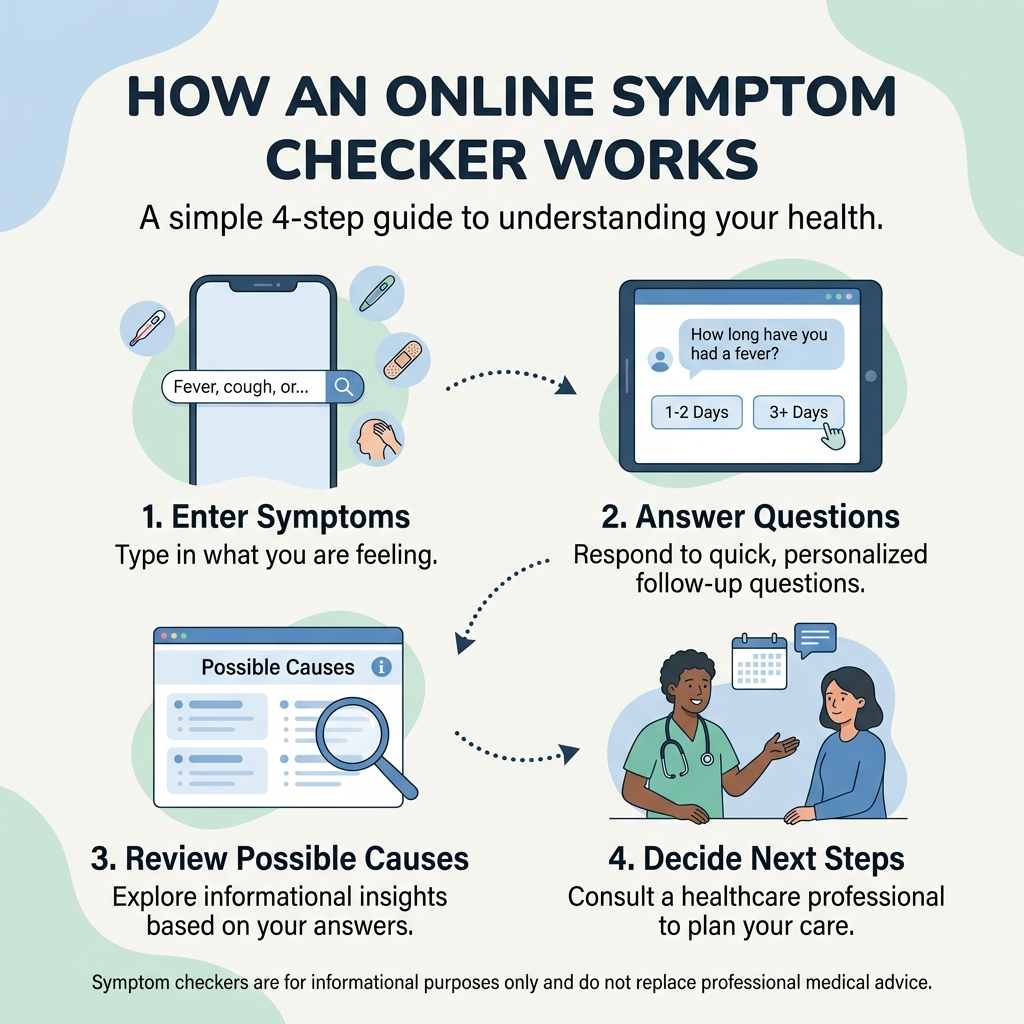
Who Benefits Most and Who Should Be Careful
Symptom checkers tend to work best for generally healthy adults dealing with minor, short-term complaints such as a mild cold, a sore muscle, or a minor stomach upset. Extra caution is needed for children and infants, whose symptoms can change quickly and who cannot describe how they feel. Older adults may have atypical presentations of serious illness, and people with chronic conditions or multiple medications face complicated interactions that a short questionnaire cannot sort out.
Pregnant people should have most new symptoms assessed by a professional, and anyone with health anxiety may find that repeated checking backfires.
Symptom Checkers, Nutrition, and Everyday Wellness
Many common symptoms, including fatigue, bloating, headaches, and changes in appetite, can be linked to daily habits such as sleep, hydration, stress, and diet. A symptom checker may mention lifestyle factors, but it cannot tell you whether a nutrition gap, a food intolerance, or an underlying medical condition is behind what you feel.
At Nutrifit essentials, we encourage a balanced approach: pay attention to your body, keep a simple log of your symptoms, meals, and sleep, and share it with a doctor or registered dietitian. That kind of record gives a professional far more to work with than a list of search results, and it helps you spot patterns over time. Supplements and diet changes should never replace medical evaluation for symptoms that are new, severe, or persistent.
The Future of Online Symptom Checkers
The field is moving quickly. Advanced AI models can already handle free-text descriptions and follow-up conversation instead of rigid menus. Symptom checkers are increasingly linked to telehealth, so a check can flow straight into a video visit if needed, and some may eventually draw on health records and wearable data such as heart rate and sleep. Regulators are also paying closer attention to tools that influence health decisions, and researchers are working to make them perform well across ages, ethnicities, languages, and levels of health literacy.
These advances may improve accuracy and convenience, but the core principle is unlikely to change: a tool that cannot examine you works best as a guide to the next step, not as the final word.
Online Symptom Checker FAQs
What is an online symptom checker?
An online symptom checker is a website or app that asks about your symptoms and suggests possible causes and next steps. It is designed to inform and guide you, not to give a medical diagnosis.
How accurate are online symptom checkers?
Accuracy varies widely between tools. Research shows that the correct diagnosis is often not listed first, though triage advice tends to err on the side of caution. Treat results as a starting point for a conversation with a healthcare professional.
Are online symptom checkers free?
Many are free, while some apps offer paid features such as consultations with clinicians. Check each tool’s pricing and terms before you use it.
Can a symptom checker diagnose me?
No. A symptom checker can suggest possibilities, but it cannot examine you, order tests, or weigh your full medical history. Only a qualified healthcare provider can diagnose a condition.
Can a symptom checker replace a doctor?
No. It is an informational tool that can help you understand your symptoms and decide how urgently to seek care. It is not a substitute for professional medical advice, diagnosis, or treatment.
Why do symptom checker results sometimes look so scary?
Tools are designed to avoid missing serious conditions, so rare possibilities can appear next to common ones. A condition showing up on a list does not mean you probably have it. Common, harmless causes are usually far more likely.
Is my information private when I use a symptom checker?
That depends on the tool’s privacy policy. Read it before you enter sensitive details, and avoid sharing identifying information unless it is truly needed.
Are AI symptom checkers better than traditional ones?
AI-based tools can understand free-text descriptions and adapt their questions, and some studies show improved performance. However, they can still make mistakes and are not a replacement for professional care. Use them for general understanding and confirm anything important with a clinician.
When should I see a doctor instead of using a symptom checker?
See a doctor if your symptoms are severe, last more than a few days, keep coming back, or are getting worse, or if you are simply worried. Seek emergency care right away for chest pain, trouble breathing, signs of stroke, or other urgent warning signs.
Can a symptom checker help with nutrition or diet concerns?
It may mention lifestyle factors, but it cannot identify a nutrient deficiency or food intolerance. For concerns about diet or nutrition, talk to a doctor or registered dietitian.
Are symptom checkers safe for children?
Children’s symptoms can change quickly and are harder to assess, so a symptom checker should never replace advice from a pediatrician or a nurse line. When in doubt about a child’s health, contact a healthcare professional.
Conclusion: Use an Online Symptom Checker as a Guide, Not a Verdict
Online symptom checkers have made health information more accessible and better organized than a raw web search. They can help you describe your symptoms, understand possible explanations, and decide how urgently to seek care. But they are screening and education tools, not diagnostic ones. Their accuracy is limited, their results can inflame anxiety or falsely reassure, and they cannot replace a clinician who can see and examine you.
Use them the way you would use a well-written health pamphlet: to get informed, to prepare questions, and to decide on next steps. When something feels seriously wrong, or simply will not go away, trust your instincts and talk to a healthcare professional.
Disclaimer: This article is provided by Nutrifit Essentials for general informational purposes only and is not medical advice. Always consult a qualified healthcare provider about any health concern.
