
Review: Ingredients, Benefits, Pros & Cons
Choosing the right facial sunscreen is about more than selecting a high SPF number. A good sunscreen should provide reliable protection against ultraviolet radiation, feel comfortable on the skin, work well with your daily skincare routine, and be easy enough to apply in the correct amount every day.
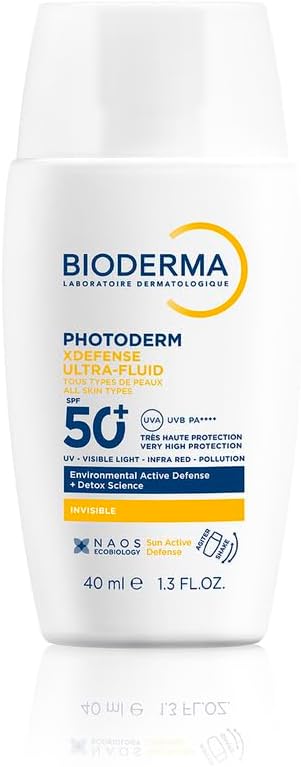
The Bioderma Photoderm Xdefense Ultra Fluid SPF50+ 40ml in Invisible is a facial sunscreen designed to protect the skin from UV radiation and other environmental aggressors. Manufactured by Bioderma under the NAOS group, this product combines high sun protection with an ultra-fluid texture and a formula containing several modern UV filters, moisturizing ingredients, and antioxidant-related components.
The product is particularly interesting for people who want a lightweight sunscreen without a traditional opaque or tinted finish. However, its small 40ml packaging, relatively high price per millilitre, and the presence of fragrance in the listed ingredient formula are important considerations before buying it.
In this detailed review, we will examine its advertised benefits, ingredients, texture, suitability for different skin types, customer feedback, application instructions, and value for money.
1. What Is Bioderma Photoderm Xdefense Ultra Fluid SPF50+?
Bioderma Photoderm Xdefense Ultra Fluid SPF50+ is a facial sunscreen formulated to provide very high sun protection. The Invisible version is intended to blend into the skin without adding an obvious makeup-like tint.
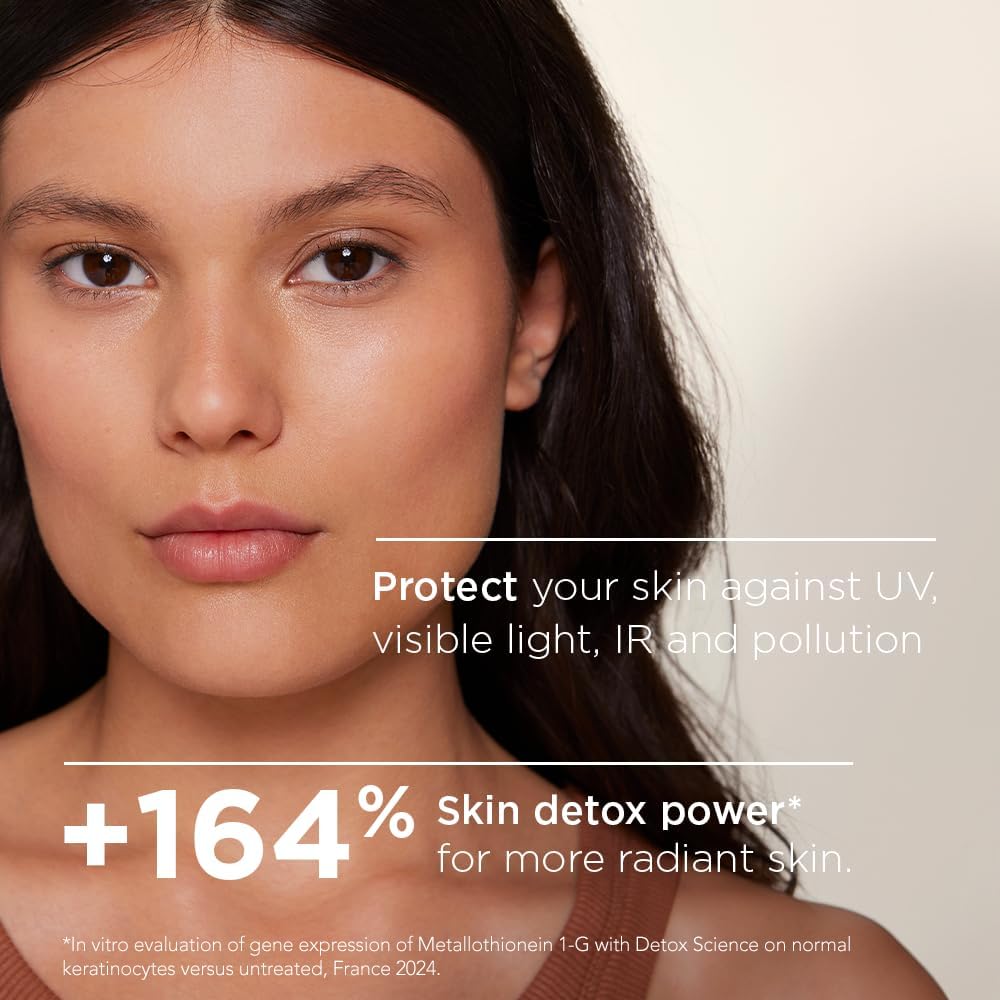
According to the product description, its protective approach extends beyond conventional UV protection to include visible light, infrared radiation, and pollution-related environmental stress. The manufacturer also promotes a technology called Environmental Active Defense and a concept called Detox Science.
These claims describe the product’s intended formulation benefits. They should not be interpreted as proof that sunscreen can remove every pollutant from the skin, reverse existing sun damage, or prevent every form of skin ageing.
The formula includes multiple organic UV filters, glycerin, sodium hyaluronate, ectoin, tocopherol, and other supporting ingredients. Together, these components are intended to provide sun protection while helping the product spread comfortably across the skin.
Product highlights
Brand: Bioderma
Product: Photoderm Xdefense Ultra Fluid SPF50+
Finish: Invisible
Sun protection: SPF50+
Package size: 40ml
Product category: Facial sunscreen
Texture: Ultra-fluid, marketed as dry-touch
Scent: Listed as unscented in the product specifications, although fragrance appears in the supplied ingredient list
Listed skin type: Dry
Country of origin: France, according to the listing
Manufacturer: NAOS, Aix-en-Provence, France
One important detail is the difference between the term unscented in the listing and the ingredient list containing Fragrance (Parfum). Consumers who are sensitive to fragrance should check the packaging of the exact product they receive and consider this ingredient before purchasing.
2. Price, Packaging and Available Shades
The supplied Amazon Saudi Arabia listing shows the Invisible version at SAR 83.95 for 40ml. Other available shade options include Brown, Golden, Light, and Very Light, although their prices may differ.
The 40ml tube is convenient for carrying in a handbag, travel bag, or everyday skincare kit. However, sunscreen is a product that needs to be applied generously and reapplied regularly. As a result, a small package may not last long when used consistently on the face and neck.
Price per millilitre
At the listed price of SAR 83.95, the approximate cost is:
SAR 83.95 ÷ 40ml = SAR 2.10 per ml.
This calculation provides a useful way to compare the product with other facial sunscreens. It does not establish whether the sunscreen is better or worse than a cheaper alternative, because texture, protection, formulation, and personal skin compatibility also matter.
3. Sun Protection: What Does SPF50+ Mean?
SPF stands for Sun Protection Factor. It primarily measures protection against UVB radiation, which is strongly associated with sunburn.
SPF50+ indicates a very high level of UVB protection when a sunscreen is applied according to the required testing conditions. It does not mean that the product blocks every UV ray or provides complete protection for an entire day.
UVA radiation is also important because it contributes to premature skin ageing and other forms of skin damage. For this reason, a sunscreen should offer broad-spectrum protection rather than relying on its SPF number alone.
The listed Bioderma formula contains several UV filters intended to provide protection across different parts of the ultraviolet spectrum.
Why high sun protection matters
Regular use of an appropriately applied sunscreen can help:
Reduce the risk of sunburn.
Protect against UV-related skin damage.
Help limit the worsening of uneven pigmentation caused by sunlight.
Reduce cumulative exposure associated with premature skin ageing.
Complement other sun-protection measures, such as shade, protective clothing, and hats.
No sunscreen eliminates all risk. Seeking shade during intense sunlight, wearing protective clothing, and avoiding prolonged unprotected exposure remain important.
4. Understanding the Environmental Defense Claims
One of the main selling points of Photoderm Xdefense is its advertised protection against several environmental aggressors.
The product description identifies ultraviolet radiation, visible light, infrared radiation, and pollution as its main areas of focus.
UV radiation
Ultraviolet radiation is the primary reason for using sunscreen. The listed UV filters are intended to help absorb UV radiation and reduce the amount reaching the skin.
Visible light
Visible light is the portion of the electromagnetic spectrum that the human eye can see. Certain wavelengths, particularly high-energy visible light, may contribute to pigmentation in susceptible skin.
The degree of visible-light protection depends on the actual formulation and its supporting evidence. The Invisible version should not automatically be assumed to provide the same visible-light protection as a tinted sunscreen containing appropriate pigments, such as iron oxides.
People concerned about persistent pigmentation should consider this distinction when comparing invisible and tinted products.
Infrared radiation
Infrared radiation is another form of solar energy. The manufacturer describes the formula as helping protect against infrared-related environmental stress. This should be understood as a formulation claim rather than a guarantee against every biological effect associated with infrared exposure.
Pollution
Pollution can expose the skin to particles and reactive compounds that contribute to oxidative stress. The product is marketed as supporting the skin’s defenses against pollution-related stress.
However, a sunscreen does not replace cleansing. Removing accumulated dirt, sweat, makeup, and sunscreen at the end of the day remains an important part of a skincare routine.
5. Ingredient Analysis: What Does the Formula Contain?
The ingredient list is one of the most useful parts of a sunscreen review because it helps explain how a product may perform beyond its SPF rating.
The supplied listing identifies several UV filters, emollients, humectants, texture-enhancing ingredients, and antioxidant-related components.
The exact concentration of each ingredient is not disclosed in the listing, so it is not possible to determine its individual contribution or compare ingredient strength precisely.
Key UV filters
| Ingredient | Main role in the formula |
|---|---|
| Bis-Ethylhexyloxyphenol Methoxyphenyl Triazine | Broad-spectrum organic UV filter that helps absorb UVA and UVB radiation |
| Butyl Methoxydibenzoylmethane | Also known as avobenzone; primarily absorbs UVA radiation |
| Diethylamino Hydroxybenzoyl Hexyl Benzoate | A UVA filter designed to provide protection against longer UVA wavelengths |
| Ethylhexyl Methoxycrylene | A formulation ingredient associated with photostabilization and supporting the sunscreen system |
These ingredients work as part of the complete formulation. The effectiveness of a sunscreen cannot be determined by examining individual filters alone; testing of the finished product is what establishes its protection rating.
Moisturizing and skin-conditioning ingredients
Glycerin: A humectant that helps attract and retain water in the outer layers of the skin. It can help reduce the feeling of dryness.
Sodium hyaluronate: A form of hyaluronic acid used to help bind water and support a hydrated skin feel.
Propanediol: A solvent and humectant that can help improve the formulation’s feel and ingredient delivery.
Diisopropyl sebacate and dicaprylyl carbonate: Emollient ingredients that can help improve spreadability and provide a smoother skin feel without necessarily making a product heavy.
Lauroyl lysine: A conditioning ingredient that may contribute to a soft, smooth finish.
These ingredients help explain why a sunscreen can provide some moisturizing benefits in addition to sun protection. Nevertheless, people with very dry skin may still need a separate moisturizer.
Antioxidant-related and environmental defense ingredients
Tocopherol: A form of vitamin E used as an antioxidant in skincare formulations. It can help protect the formula against oxidation and may contribute to skin-conditioning benefits.
Ectoin: An ingredient used in skincare for its ability to support hydration and help protect biological structures against environmental stress under appropriate formulation conditions.
Mannitol, xylitol and rhamnose: These ingredients can serve formulation and skin-conditioning functions. Their presence does not independently establish the clinical effectiveness of the product’s overall detoxification claims.
Trimethoxybenzyl Acetylsinapate: An ingredient associated with antioxidant-related cosmetic formulations.
The manufacturer’s Detox Science description refers to supporting natural cellular defense and detoxification mechanisms, including the NRF2 pathway. This is a manufacturer claim about the formulation’s intended biological activity; the product listing alone does not provide enough clinical data to quantify its real-world effect on individual users.
Texture and formulation ingredients
Silica can help modify texture and reduce a greasy appearance. Bentonite can support the formulation’s consistency, while xanthan gum helps stabilize the product.
Other ingredients, such as cetyl phosphate and polysorbate 60, support formulation stability and the mixing of components.
The complete formula is more important than any single ingredient when assessing how the sunscreen spreads, dries down, and performs on the skin.
Fragrance consideration
The supplied ingredient list includes Fragrance (Parfum), even though the specifications describe the sunscreen as unscented.
This inconsistency is worth checking before buying. Fragrance does not automatically make a product unsuitable, but it can be a concern for people with fragrance sensitivity, eczema-prone skin, or a history of irritation from fragranced skincare.
If you have reactive skin, test a small amount on a limited area first. A fragrance-free sunscreen may be a more appropriate alternative if fragrance repeatedly triggers irritation.
6. Texture, Finish and Everyday Wear
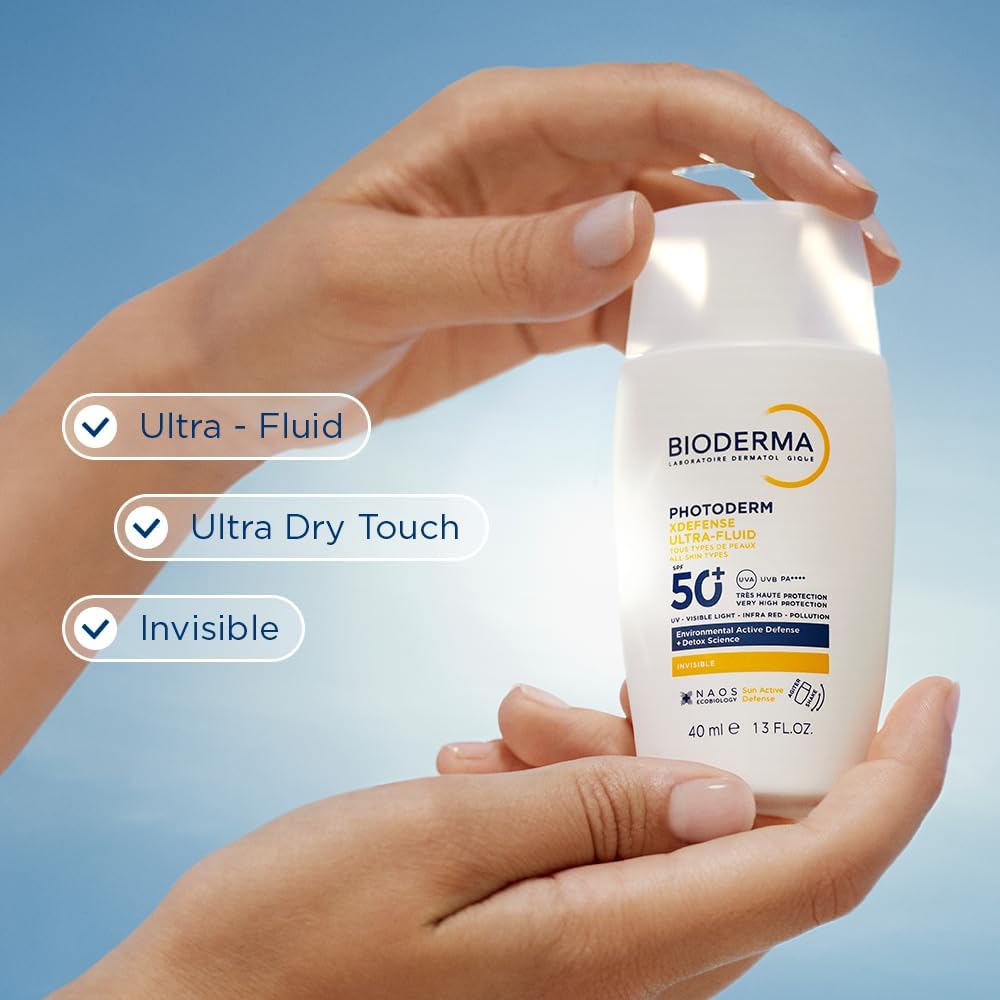
The manufacturer describes the formula as ultra-fluid, ultra-dry-touch, and imperceptible. These descriptions suggest a lightweight sunscreen designed to spread easily and leave little visible residue.
Customer feedback in the supplied listing is broadly consistent with a thin texture, although individual experiences differ.
Some reviewers praise its absorption, hydration, and comfortable finish. Others mention that it is runny and can spread too quickly during application.
What does an ultra-fluid texture mean?
An ultra-fluid sunscreen has a thinner consistency than many traditional creams. This may be helpful for people who dislike thick sunscreen layers or want a product that fits into a daily skincare routine.
However, a thin consistency also requires careful application. The product may drip or spread onto the fingers before it reaches the face, particularly if the tube is squeezed too quickly.
The listing instructs users to shake the product well before application. Follow the instructions on the actual packaging, dispense the product carefully, and apply it evenly across the face and neck.
Does it leave a white cast?
The Invisible version is marketed as an invisible finish, meaning it is intended to blend without an obvious tint or visible white layer.
That is a useful feature for people who prefer an untinted sunscreen. However, the supplied customer reviews do not establish that every user will experience a completely invisible finish under all lighting conditions and on every skin tone.
The available Brown, Golden, Light, and Very Light options may be worth investigating for people who prefer a tinted finish. Their shade suitability should be checked against the actual product swatches and packaging.
Can it be worn under makeup?
Its lightweight texture may make it a reasonable candidate for use under makeup. However, the listing does not establish compatibility with every foundation, primer, or powder.
For best results, allow the sunscreen to settle before applying makeup. Avoid excessive rubbing, which may cause some skincare and makeup layers to pill.
7. Which Skin Types May Benefit Most?
The product listing identifies dry skin as the intended skin type. Its glycerin, sodium hyaluronate, and emollient ingredients may help make the formula comfortable for some people who experience dryness.
However, skin type suitability is individual. A sunscreen that feels comfortable on one person may feel too shiny, too drying, or irritating to another.
Dry skin
People with dry skin may appreciate the moisturizing components and lightweight texture. Those with significant dryness, flaking, or a compromised skin barrier may still benefit from applying a compatible moisturizer before sunscreen.
Normal skin
Normal skin may be well suited to an ultra-fluid sunscreen, particularly for people who prefer a lighter alternative to richer creams.
Oily skin
The advertised dry-touch finish may appeal to people who dislike greasy sunscreens. Nevertheless, the product is not specifically established by the supplied listing as an oil-control treatment, and the finish may vary according to climate and individual skin characteristics.
Combination skin
People with combination skin may find the thin texture convenient. Those with oily areas and dry cheeks should observe how the sunscreen behaves across different parts of the face.
Sensitive skin
The listed fragrance is an important consideration for sensitive skin. People who frequently experience stinging, redness, or irritation should check the current packaging and consider a fragrance-free alternative if needed.
Acne-prone skin
The product listing does not establish that this sunscreen is non-comedogenic. People prone to clogged pores should monitor their skin after introducing it and remove the sunscreen thoroughly at the end of the day.
A product’s suitability for acne-prone skin cannot be determined from its SPF rating alone.
8. How to Apply Bioderma Photoderm Xdefense Correctly
Even a high-SPF sunscreen may provide less protection than expected if too little is applied or if it is not reapplied when needed.
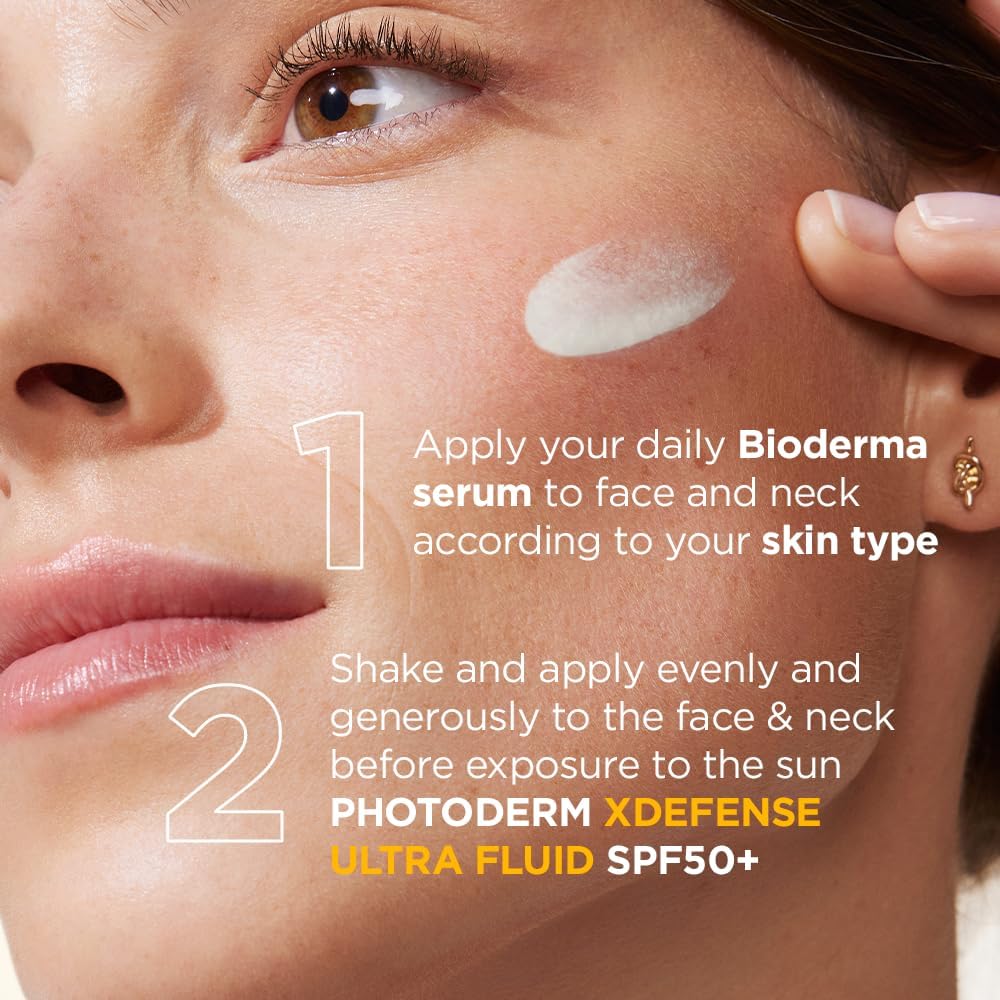
The manufacturer instructs users to shake the product well and apply it evenly and generously to the face and neck before sun exposure.
Step-by-step application
Step 1: Prepare your skin. Cleanse your face and apply your usual moisturizer if needed. Let your skincare settle before applying sunscreen.
Step 2: Shake the bottle or tube as directed. Follow the exact instructions printed on your product packaging.
Step 3: Apply generously. Cover the entire face, including the forehead, cheeks, nose, chin, and areas near the hairline. Do not forget the ears and neck.
Step 4: Apply before sun exposure. Follow the label’s specified application timing. Many sunscreen guidelines recommend applying sunscreen around 15 minutes before going outdoors, but the packaging instructions take priority.
Step 5: Reapply regularly. As a general guideline, reapply at least every two hours while outdoors and after swimming, heavy sweating, or towel drying. The supplied listing does not establish that this particular product is water-resistant, so do not assume that it provides reliable protection during swimming or heavy sweating.
Step 6: Use additional protection. Wear a hat, seek shade when the sun is strongest, and use protective clothing when practical.
How much sunscreen should you use?
The amount required depends on the area being covered and the product’s application characteristics. For laboratory SPF testing, sunscreen is typically applied at 2mg per square centimetre of skin.
For everyday facial application, people often use the two-finger method as a practical starting point, but the amount dispensed varies with the size of the fingers and the product packaging. Ensure that you cover the face and neck adequately rather than using a very thin layer simply to make the product last longer.
9. Customer Reviews: What Are Buyers Saying?
The supplied Amazon Saudi Arabia listing reports an average rating of 4.5 out of 5 stars from 635 global ratings.
The displayed rating distribution is:
Five stars: 80%
Four stars: 8%
Three stars: 5%
Two stars: 2%
One star: 5%
The distribution indicates that most displayed ratings are positive, but the critical reviews are also useful because they identify practical concerns that may affect purchasing decisions.
These figures reflect the listing at the time the supplied information was captured. Ratings and review counts can change.
Common positive experiences
Lightweight texture: Some reviewers appreciate the thin consistency and the way the product settles on the skin.
Comfortable hydration: A reviewer from the United Kingdom described the product as very hydrating and easy to absorb.
Oil-free feel: A reviewer from Turkey praised the non-greasy sensation and the comfortable finish.
Overall satisfaction: Several Saudi Arabia and international reviews gave the product five stars, although some short reviews provide little detail about long-term performance.
Common complaints
Small package size: Some buyers feel that 40ml is a small quantity for the price, especially when sunscreen is used every day.
Runny consistency: A reviewer described the formula as runny but pleasant once applied. This is a practical consideration for anyone who prefers thicker creams.
Packaging and delivery concerns: Some reviews mention damaged outer packaging, a product that appeared unsealed, or concerns about exposure to heat during delivery.
Variable wear: One reviewer reported that the sunscreen transferred onto a headscarf. This is an individual experience rather than proof that the product will transfer in the same way for everyone.
Packaging complaints do not establish that every unit is affected. Nevertheless, checking the seal, package condition, batch information, and seller reliability is sensible when buying skincare online.
How should these reviews be interpreted?
Customer reviews can help explain the sensory experience of a product, but they cannot independently verify SPF performance, UVA protection, or clinical detoxification claims.
A high rating is encouraging, but it should be considered alongside the ingredient list, the product’s suitability for your skin, correct application, and the credibility of the seller.
10. Pros and Cons of Bioderma Photoderm Xdefense SPF50+
Pros
Very high SPF rating: SPF50+ is designed to provide a high level of UVB protection when applied correctly.
Multiple UV filters: The listed formula includes several organic UV filters intended to support broad-spectrum sun protection.
Lightweight texture: Its ultra-fluid consistency may suit people who dislike thick sunscreen creams.
Invisible finish: The untinted version is designed to blend without an obvious cosmetic tint.
Moisturizing components: Glycerin and sodium hyaluronate may help support skin hydration.
Antioxidant-related ingredients: Tocopherol and other supporting components complement the manufacturer’s environmental defense positioning.
Suitable for daily routines: Its compact size and lightweight design may make it convenient for everyday facial use.
Generally positive customer feedback: The supplied listing reports a 4.5/5 average rating.
Cons
Relatively expensive per millilitre: At SAR 83.95 for 40ml, frequent users may find the cost adds up.
Small package: Generous application and regular reapplication mean the tube may not last long.
Runny consistency: The thin formula may be messy to dispense or apply for some users.
Fragrance-listing inconsistency: The specifications say unscented, but the ingredient list includes Fragrance (Parfum).
Water resistance is not established: The supplied listing does not confirm a water-resistance claim.
Tint suitability varies: The Invisible version does not provide the same cosmetic coverage as a tinted product.
Sensitive skin may react: Fragrance and other formula components may not suit every reactive skin type.
Environmental defense claims need context: The supplied listing does not provide enough independent clinical data to quantify every advertised benefit.
11. Is Bioderma Photoderm Xdefense SPF50+ Worth Buying?
This sunscreen may be worth considering if you want a high-SPF facial product with a lightweight texture and an untinted finish.
Its combination of multiple UV filters, moisturizing ingredients, and a fluid formulation makes it an interesting option for people who want sun protection without the heavy feel associated with some creams.
However, the decision depends on your priorities. If you need a larger package at a lower cost per millilitre, another sunscreen may offer better value. If you have fragrance-sensitive skin, the ingredient list deserves particular attention. If you need protection for swimming or intense exercise, choose a product with clearly stated and appropriate water-resistance claims.
For people with pigmentation concerns, a tinted sunscreen may be worth comparing with the Invisible version, especially when visible-light protection is a priority.
The most important consideration is not the brand name or the number of advertised benefits. It is whether the sunscreen offers appropriate tested protection, suits your skin, and can be applied generously and consistently.
12. Buying Advice for Amazon Customers
The supplied listing offers the Invisible, Brown, Golden, Light, and Very Light versions. Before placing an order, confirm that the selected shade matches the product you intend to purchase.
A few precautions can help reduce avoidable problems:
Check the seller and whether the product is fulfilled by Amazon or another retailer.
Confirm the selected variant, package size, and price before checkout.
Inspect the outer packaging and product seal on arrival.
Check the batch information and expiry or period-after-opening instructions where provided.
Avoid using a product if its packaging appears tampered with, its contents look unusual, or its storage history raises concerns.
Contact the seller or retailer if the item arrives damaged, unsealed, or with signs of improper storage.
The listing mentions free returns and a 15-day return period, but return eligibility can depend on the order and the retailer’s current terms. Check the conditions displayed at checkout.
13. Frequently Asked Questions
Is Bioderma Photoderm Xdefense Ultra Fluid SPF50+ good for daily use?
It is designed as a facial sunscreen and may be suitable for daily use if it agrees with your skin. Apply it generously, reapply as required, and follow the product’s directions.
Does Bioderma Photoderm Xdefense SPF50+ leave a white cast?
The Invisible version is marketed as an untinted formula intended to blend into the skin without an obvious white layer. However, the actual finish may vary depending on application amount, skin characteristics, and lighting.
Is it suitable for dry skin?
The product listing identifies dry skin as its intended skin type. Glycerin and sodium hyaluronate may help with hydration, but very dry skin may still require a separate moisturizer.
Can people with oily skin use it?
Some people with oily skin may appreciate its advertised dry-touch finish. However, the listing does not establish that it provides oil-control treatment or guarantees a matte finish throughout the day.
Is it suitable for sensitive skin?
It may be tolerated by some people, but the supplied ingredient list includes fragrance. Those with fragrance sensitivity or a history of sunscreen reactions should review the packaging and consider patch testing or choosing a fragrance-free product.
Does it help with pigmentation and dark spots?
Consistent sunscreen use can help prevent UV exposure from worsening certain forms of pigmentation. However, this product should not be considered a standalone treatment for melasma, dark spots, or other pigmentary conditions.
Does it protect against visible light and pollution?
The manufacturer advertises protection against visible light, infrared radiation, and pollution-related environmental stress. The supplied listing does not provide enough independent evidence to quantify the degree of protection against each of these factors. An invisible sunscreen should not automatically be assumed to provide the same visible-light protection as a suitably tinted formula.
Is it water-resistant?
Water resistance is not established by the supplied product information. Do not rely on it as a water-resistant sunscreen unless the packaging explicitly confirms this property.
Can I apply it under makeup?
Its lightweight texture may work well under makeup. Allow it to settle before applying foundation, and avoid vigorous rubbing if you experience pilling.
How often should I reapply it?
As a general sunscreen guideline, reapply at least every two hours during outdoor exposure and after swimming, heavy sweating, or towel drying. Follow the product’s specific instructions.
How long does the 40ml tube last?
There is no single answer because usage depends on the amount applied, the area covered, and the frequency of reapplication. Using a generous amount on the face and neck every day will consume the tube more quickly than occasional use.
Is Bioderma Photoderm Xdefense worth the price?
It may be worth the price if you value its lightweight formulation, high SPF rating, and invisible finish. If cost per millilitre is your main concern, compare it with larger facial sunscreen packages before deciding.
Is the product fragrance-free?
The supplied listing describes it as unscented, but the ingredient list includes Fragrance (Parfum). Check the actual packaging or the manufacturer’s current ingredient information before buying if fragrance is a concern.
14. Product Comparison Table
The following table summarizes the main characteristics of Bioderma Photoderm Xdefense Ultra Fluid SPF50+ based on the supplied listing and the general considerations discussed above.
| Feature | Details |
|---|---|
| Brand | Bioderma |
| Product name | Photoderm Xdefense Ultra Fluid |
| Variant reviewed | Invisible |
| SPF rating | SPF50+ |
| Package size | 40ml |
| Listed price | SAR 83.95 |
| Approximate price per ml | SAR 2.10 |
| Texture | Ultra-fluid |
| Advertised finish | Ultra-dry-touch and invisible |
| UV filters | Multiple organic UV filters |
| Moisturizing ingredients | Glycerin, sodium hyaluronate, propanediol |
| Antioxidant-related ingredients | Tocopherol and other supporting ingredients |
| Manufacturer’s additional claims | Environmental defense against UV, visible light, infrared and pollution |
| Listed skin type | Dry |
| Fragrance status | Listing says unscented; ingredient list includes parfum |
| Water resistance | Not confirmed in supplied information |
| Amazon rating in supplied listing | 4.5/5 from 635 ratings |
| Country of origin | France, according to the listing |
| Best reason to consider it | High SPF with a lightweight, untinted finish |
| Main drawback | Small size and relatively high cost per millilitre |
15. Quick Pros and Cons Comparison
| Pros | Cons |
|---|---|
| High SPF50+ rating | Only 40ml per package |
| Lightweight fluid texture | Can be difficult to handle because it is runny |
| Invisible, untinted finish | May not suit everyone seeking visible-light protection |
| Contains moisturizing ingredients | Very dry skin may need additional moisturizer |
| Multiple UV filters | Exact filter concentrations are not disclosed |
| Positive average customer rating | Some negative reports about packaging and delivery |
| Convenient for everyday facial use | Water resistance is not confirmed |
| Antioxidant-related ingredients | Fragrance appears in the listed formula |
16. Final Verdict
Bioderma Photoderm Xdefense Ultra Fluid SPF50+ 40ml (Invisible) is a high-SPF facial sunscreen worth considering for people who prefer lightweight sun protection and an untinted finish. Its combination of UV filters, moisturizing ingredients, and fluid texture may make it convenient for everyday skincare.
Its strongest practical advantages are the high SPF rating, the advertised lightweight finish, and the presence of ingredients that support hydration and skin conditioning. The main drawbacks are the relatively small package, the price per millilitre, the runny consistency, and the need to clarify the fragrance information.
Overall, it is a reasonable option to evaluate if the texture and finish match your preferences. However, it is not automatically the best sunscreen for every skin type or budget. Compare its ingredients, price, water-resistance information, and compatibility with your skin before making a final decision.
Our recommendation: Consider Bioderma Photoderm Xdefense SPF50+ if you want a lightweight, invisible facial sunscreen for regular daily use. If you have fragrance-sensitive skin, require water resistance, or need a more economical option for frequent application, compare alternatives before buying.
Detailed Context: What Buyers Should Understand Before Choosing This Sunscreen
A sunscreen review should go beyond the product’s marketing language. SPF, UVA protection, texture, skin compatibility, packaging, and consistent application all contribute to the product’s real-world usefulness.
First, an SPF50+ rating is valuable only when the sunscreen is applied in a sufficient amount. Applying a very thin layer to make a small tube last longer can substantially reduce the protection achieved. This makes the 40ml package size an important practical consideration rather than merely a packaging detail.
Second, broad-spectrum UV protection and visible-light protection are not identical. The product’s Invisible version is marketed for environmental defense, but consumers dealing with pigmentation should not assume that an untinted formula necessarily performs like a tinted sunscreen containing visible-light-attenuating pigments. People with persistent pigmentation may benefit from discussing their sunscreen choices with a qualified dermatologist.
Third, skin type descriptions are useful starting points, not guarantees. Although the listing identifies dry skin, people with normal, oily, combination, or sensitive skin may respond differently to the same formula. The fragrance discrepancy in the listing makes checking the current ingredient declaration particularly important for anyone with reactive skin.
Fourth, consumer ratings reflect personal experience rather than laboratory testing. A reviewer can accurately describe whether a sunscreen feels greasy, absorbs quickly, or transfers onto clothing, but a customer review cannot independently verify SPF50+ performance or the manufacturer’s biological detoxification claims.
Finally, buying from a reliable seller and storing sunscreen appropriately are essential. Check the seal and packaging when the product arrives, follow the storage directions, and avoid leaving sunscreen in excessive heat. If the product arrives damaged or appears tampered with, contact the retailer rather than assuming the contents are safe to use.
The best sunscreen is one that provides appropriate tested protection, suits your skin, fits your budget, and can be applied generously and consistently. Bioderma Photoderm Xdefense Ultra Fluid SPF50+ may meet those needs for some buyers, but its suitability should be assessed alongside these practical considerations rather than its advertised benefits alone.
🛒 Buy Now:
You can purchase the Bioderma Photoderm Xdefense Ultra Fluid SPF50+ from Amazon Saudi Arabia:
👉 Buy on Amazon.sa
